Why patchwork automation and vibe compliance don’t hold up
Global tax compliance has changed in kind, not just in degree.
For years, tax obligations grew roughly in step with company expansion. Enter a new market, add a filing. Launch a new product, review the rules. That model no longer holds. Today, compliance requirements compound as businesses scale, driven by broader tax bases, faster enforcement, and increasingly blurred business models.
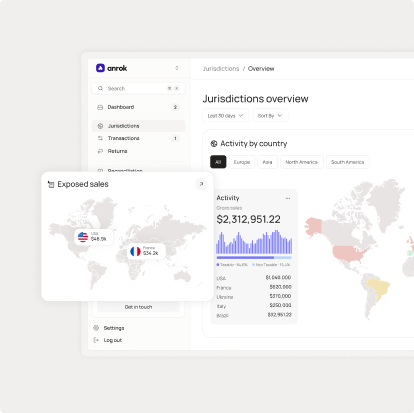
In Anrok’s 2025 proprietary data report—which analyzed anonymized transaction and filing data across fast-growing businesses— the same pattern appears again and again: As companies grow, the number of jurisdictions they’re exposed to increases sharply, filing volume explodes, and a far greater share of revenue becomes taxable. By enterprise scale, more than half of total revenue is typically subject to sales tax or VAT, often across dozens of regions.
In this environment, compliance approaches built on partial automation and manual judgment start to break not suddenly, but predictably.
Why global compliance is getting harder
Expansion is no longer linear
Selling into a new market used to introduce one additional obligation. Today, it generates several at once. A single expansion can trigger sales tax or VAT, economic nexus thresholds, and local or home-rule requirements.
The impact of this stacking effect shows up clearly in the data. As companies scale from early-stage to enterprise:
- Jurisdiction exposure grows from a single region to 15+ U.S. states and more than a dozen international jurisdictions
- Annual filing volume increases from 2 filings per year to 90–150+
- Taxable revenue rises from roughly 20% of total revenue to over 50%
This is why tax complexity accelerates so quickly. Each new market doesn’t add one more task—it multiplies the surface area of risk.
Business models no longer map cleanly to tax rules
At the same time, governments have moved away from taxing based on labels and toward taxing based on functionality.
Throughout 2025, both U.S. states and international jurisdictions expanded tax bases to include categories that were historically exempt or ambiguous. Examples include SaaS, cloud computing, streaming subscriptions, IT services, digital advertising, and data services. In parallel, states issued clarifying guidance that folded tariffs directly into taxable sales price calculations.
What matters here isn’t any single rule change. It’s the pattern. Taxability increasingly depends on how a product works, how it’s delivered, and where it’s used—not how it’s marketed. For companies with mixed revenue models, this makes static rules and high-level categorizations insufficient.
Regulatory acceleration in 2025–2026
Tax complexity isn’t just increasing. Regulatory enforcement is accelerating and becoming more technical. Based on Anrok’s 2025 mid-year and end-of-year tax research, three shifts stand out:
- Broader tax bases driven by delivery and usage, not labels. State and federal governments (like Maryland, Maine, Washington, the Phillipines, and the UK) are expanding tax bases to capture a wider range of transactions that don’t fit cleanly into traditional product categories. Taxability is increasingly determined by how value is delivered, accessed, or used, not how it’s marketed.
- More consistent application across seller type and location. Jurisdictions are applying these rules more uniformly across domestic and non-domestic sellers, reducing historical gray areas for remote or platform-based transactions. As a result, companies are triggering registration, filing, and reporting obligations earlier.
- Faster, more structured enforcement mechanisms. Authorities are modernizing enforcement through e-invoicing, structured reporting, and shorter compliance timelines. The EU’s VAT in the Digital Age (ViDA) framework is one visible example, introducing mandatory e-invoicing and near-real-time reporting for cross-border transactions beginning in 2026.
As enforcement becomes faster and more granular, compliance approaches built on inferred logic, partial automation, or post-hoc reconciliation break down not because rules changed overnight, but because tolerance for ambiguity is disappearing.
What this looks like for finance teams
For finance teams, the operational consequences appear well before companies reach enterprise scale.
Anrok’s data report found clear inflection points:
- At $5–10M in revenue, companies are already managing close to 40 filings per year
- At $30–50M, filing volume commonly exceeds 80 returns annually
- Beyond that, manual processes become unsustainable without dedicated headcount or full automation
The hidden cost isn’t just time. Teams lose 25–30 hours per month to manual tax work at a relatively modest scale. International expansion is delayed by months because compliance readiness lags behind product and sales. And exposure compounds quietly across jurisdictions as rules change.
Fragmentation makes this worse. Most companies rely on one system for calculation, separate vendors or consultants for filing, and spreadsheets to reconcile everything. Automation exists, but no single system owns the outcome.
The limits of automation and “vibe compliance”
As global tax complexity has increased, many tools have leaned harder on automation as the solution. In practice, much of that automation stops short of full compliance.
This gap has given rise to what many finance teams experience as vibe compliance: tax outcomes that look reasonable on the surface, but are generated through inferred rules, incomplete coverage, or opaque logic that can’t be clearly sourced, explained, or defended.
This creates a real — and growing — audit and auditor risk.
In practice, vibe compliance often shows up in systems that claim broad automation but rely on the following:
- Tax rules inferred from scraped or unstructured guidance rather than verified jurisdictional requirements
- Edge cases resolved through undocumented judgment calls, instead of reviewed and approved tax positions
- Outputs with no clear audit trail, tying decisions back to authoritative sources or accountable reviewers
Increasingly, some platforms compound this risk by over-relying on LLMs to interpret tax guidance, generate tax logic, or “fill in” regulatory gaps. While AI can accelerate research and workflow, models that cannot clearly cite sources, show decision lineage, or identify a responsible reviewer introduce significant exposure under audit.
Under audit, these systems fail because they can’t substantiate correctness: tax positions can’t be traced to verified rules, edge cases lack documented approval, and outputs don’t reconcile cleanly to authoritative requirements.
In these models, teams still end up:
- Interpreting tax authority guidance published as PDFs
- Manually validating exceptions where automation stops
- Relying on consultants or internal judgment to backfill gaps
That approach may appear to work at low volume, but it degrades predictably under audit, regulatory change, or scale — when accuracy, traceability, and accountability matter most.
Why patchwork compliance degrades over time
Traditional global compliance models don’t usually fail outright. They degrade in stages.
Early on, compliance is handled locally and reactively. This works for single-region operations but breaks as soon as new markets or revenue types are introduced. Next comes fragmentation: different tools and vendors by region, consultants filling gaps, and data drifting out of sync. Eventually, filing volume spikes and compliance itself becomes a blocker to expansion.
At this stage, automation exists but it isn’t unified. Teams spend more time managing vendors and reconciling systems than managing risk.
The emerging standard for global compliance
As companies scale, compliance requirements converge toward a common set of needs. Modern global compliance requires a single system that owns the full lifecycle (registration, calculation, filing, remittance, and reconciliation) with centralized visibility into global exposure and continuous updates as rules change.
Just as importantly, it requires clear ownership and defensible positions. In a world of faster enforcement and shrinking gray areas, surface-level automation isn’t enough.
What that standard looks like in practice
At scale, finance teams consistently need:
- One system accountable for outcomes — not a handoff between calculation tools, local filers, and spreadsheets
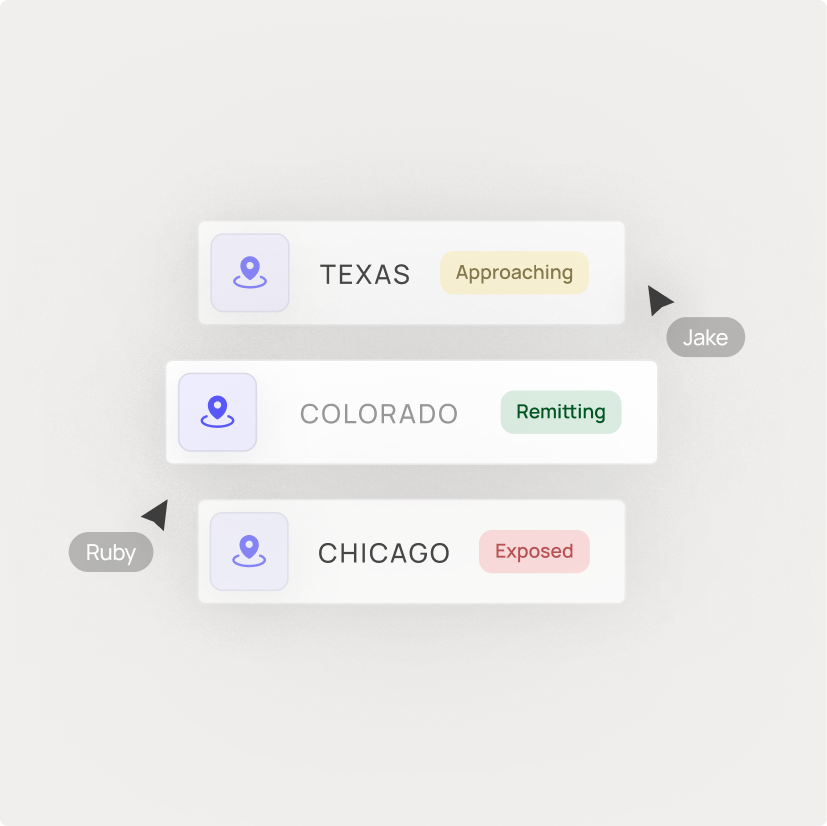
- Verified coverage across jurisdictions, with clear visibility into where filings are live versus pending
- The ability to trace filings back to reviewed positions, authoritative rules, and accountable experts
- Support for modern revenue models and evolving finance stacks without re-architecting compliance each year
Anrok was built around these realities
Instead of layering automation on top of fragmented workflows, Anrok owns the global compliance lifecycle end-to-end and all within a single platform, without third-party logins, contracts, or vendor coordination.
Anrok supports modern, mixed revenue models by default and integrates directly with the billing, invoicing, and finance systems teams already use. Filings are reviewed and supported by Anrok’s in-house tax experts, ensuring outcomes are accurate, traceable, and defensible as rules evolve.
“The deciding factor with Anrok was the solution’s ability to handle US and global sales tax in one platform. We didn't want to piece together multiple solutions or maintain separate workflows for different regions.” — Eli Ross, COO at Brilliant Worldwide, Inc.
More proof our model works at scale:
- End-to-end VAT/GST compliance handled directly on Anrok’s platform, including registrations, filings, remittance, and reconciliation
- Coverage across dozens of international jurisdictions, with live visibility into global exposure
- In-house tax attorneys, CPAs, and technologists responsible for filing accuracy and audit support
- Rated the highest-reviewed sales tax and VAT compliance platform on G2
That combination — software plus accountable expertise — is what allows teams to stay ahead of regulatory change rather than react to it.
Global tax compliance is no longer a background task. It’s operational infrastructure.
The companies that scale successfully will be the ones that recognize how quickly complexity compounds and choose systems designed for that reality. The data makes this shift clear. Anrok was built for it.