.png)
While many teams focus on customer acquisition costs or churn, sales and use tax can bite into margins by driving all-in pricing up for purchasers and turning them away. In states where combined rates now exceed 10%, this effect is more impactful.
By noting these high-burden jurisdictions, your business can better implement pricing and procurement strategies, inventory placement, and expansion plans. To identify the most expensive states for e-commerce sales in 2026, Anrok drew on data from the Tax Foundation, the Sales Tax Institute, and Bloomberg Tax—and translated those findings into actionable guidance for cross-state tax planning.
How the e-commerce sales tax burden is measured
Evaluating sales tax impact in U.S. states requires looking beyond the headline state sales tax rate. The true impact to businesses can be appreciated by looking into local rates, which can substantially impact the combined average rate. The combined rate includes both state-level and local district taxes. E-commerce businesses making remote sales must also be wary of economic nexus rules, as covered by the Sales Tax Institute, a sales tax training organization.
Not all sales tax obligations are created equally and the rules governing what is taxable can vary significantly from state-to-state. For instance, some states exempt things like groceries, clothing, or digital goods entirely, whereas others tax them at full or reduced rates. For e-commerce sellers, these product-based distinctions can meaningfully shape tax mitigation strategies. A business selling a mix of taxable and exempt goods might find that its effective tax burden differs from the headline combined rate, depending on which states it has nexus in. Sellers operating across multiple states should match their product catalog against each state’s taxability rules, not just their rates, to accurately forecast tax liability.
Further, economic nexus thresholds determine when your sales volume, measured by either dollar amount or number of transactions, requires you to collect and remit tax in a state where you don’t have physical presence. In high-rate states, hitting these thresholds, and failing to timely register to collect, report, and remit sales tax, can have a major impact on your ability to do business in a state, and cause you to incur penalties and interest.
The ranking: 10 most expensive states for e-commerce sales tax
Based on 2026 combined state and local tax rates in the U.S., using Tax Foundation data, the following 10 states topped the list for tax expense. For businesses aiming to scale quickly, these regions are where tax automation services and strategic pricing will be most critical.
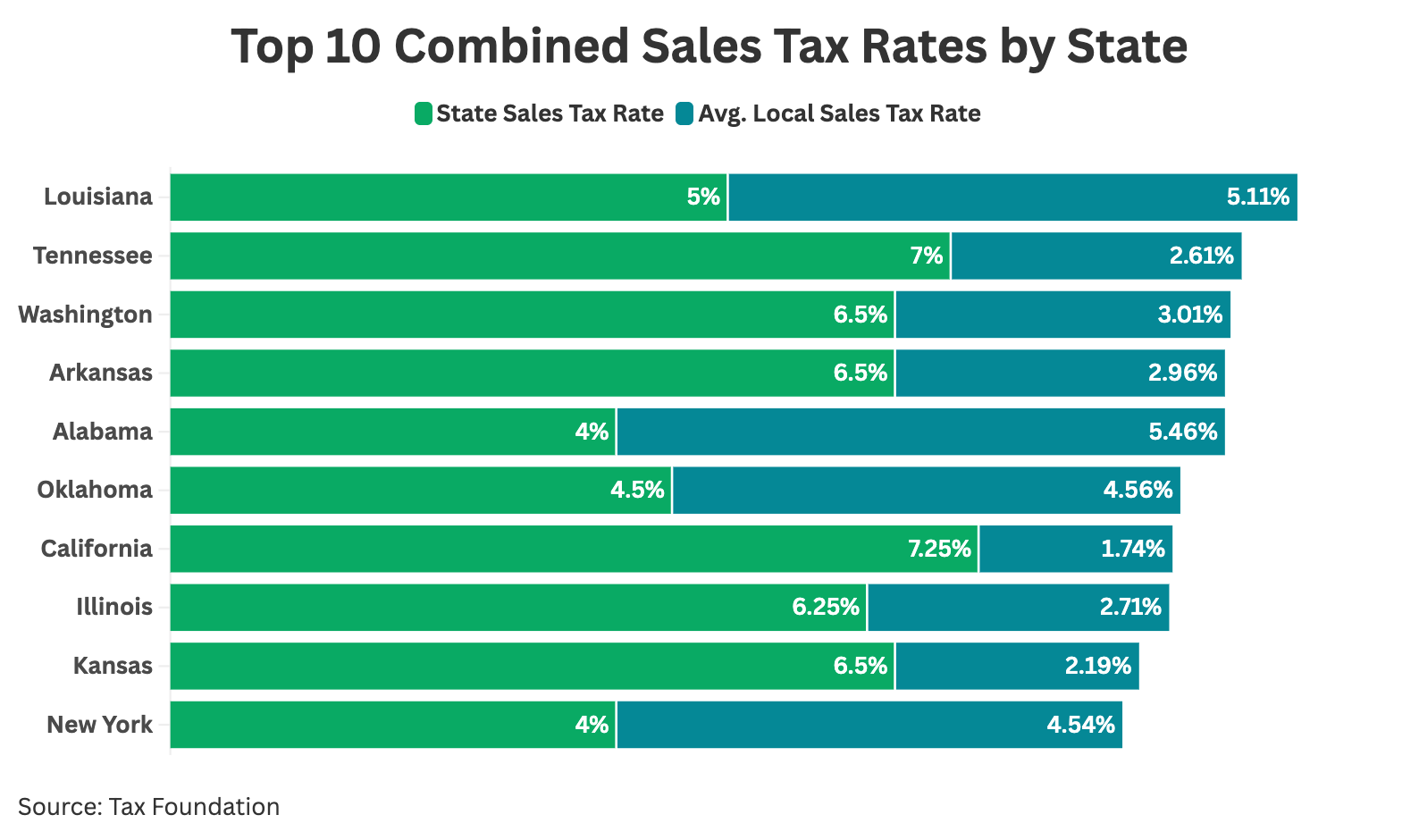
When combining both the sales tax rate and the average local sales tax rate for these top 10 states, the total figure shakes out as follows:
- Louisiana — 10.11%
- Tennessee — 9.61%
- Washington — 9.51%
- Arkansas — 9.46%
- Alabama — 9.46%
- Oklahoma — 9.06%
- California — 8.99%
- Illinois — 8.96%
- Kansas — 8.69%
- New York — 8.54%
The true tax situation is more complex than these percentages indicate. Take Louisiana, for example. Louisiana is particularly notorious for its numerous parish-level taxes, which can make determining which local rates are applicable a manual nightmare for any SaaS or remote e-commerce company. Reporting requires breaking out sales in each Parish individually, which can be time consuming and result in a drain on resources.
Washington and Tennessee, which don’t have state income taxes, rely heavily on sales tax to fund state operations. Given this reliance, they tend to be more aggressive in auditing and leveraging broader definitions for the taxability of goods of services, specifically SaaS, PaaS, and IaaS.
Other states, like Utah, have complex shifts between origin-based and destination-based sourcing. For intrastate sellers this could result in different sourcing rules between sales of physical goods and digital services.
High-volume states like California and New York may rank lower than others in average combined rates, but their massive market sizes concentrated in their major cities with high local rates, often result in some of the highest combined rates in the country. The high population and resulting volume in sales in these cities often mean e-commerce sellers hit economic nexus thresholds rather quickly, making economic nexus exposure tracking important. Remote sellers engaging in multistate sales may be exposed to all of these factors, which is why developing a framework for operating in a multistate sales model is crucial.
Cross-state planning framework
If your organization is nearing nexus thresholds in any of the top 10 states, your planning strategy should be centered around four pillars:
- Nexus threshold monitoring: Most states trigger their nexus at $100,000 in sales and/or 200 transactions, as outlined by Bloomberg Tax. Please note, some states are moving toward eliminating transaction-count thresholds in favor of revenue only.
- Filing frequency adjustments: As sales volumes grow, states may move you from annual to monthly filing, which increases administrative and compliance overhead. If this applies, automating the process before the holiday rush or year-end peaks is critical.
- Adhering to marketplace facilitator rules: Be aware that if you sell through platforms like Amazon, Etsy, and more, the facilitator is often responsible for collecting tax. However, those sales will still count toward your economic nexus threshold calculation in some states. Additionally, in states like Washington, marketplace sales may count toward your Business & Occupation (B&O) tax obligations.
- Watching for digital goods and SaaS tax exemptions: Finally, not all high-tax states treat digital products and services as equal. While prewritten software is typically taxable wherever software is taxable, custom software is often exempt, so audit your product catalog for mitigation opportunities based on your product tax classifications..
All of these tips can help you ensure adherence to all tax calculations and avoid underreporting.
The tax cost of growth
As 2026 continues, the complexity of e-commerce sales tax compliance will only increase as states seek to capture revenue from a growing industry. For finance leaders at high-growth companies, your goal shouldn’t just be to be compliant but also to ensure that tax risk and exposure are factored into every expansion decision. Whether you’re looking at territory planning, product pricing, or something else, addressing your position in these high-tax jurisdiction states in the next planning cycle can protect your business from unexpected payments.
.png)