Keeping up with compliance
It's hard to keep up with the Kardashians. Harder? Keeping up with sales tax rules across 50 states.
Just ask Kim, whose clothing brand Skims recently paid $200K to settle with the state of New Jersey. The violation wasn't tax evasion or fraud—it was charging customers sales tax on clothing, which is exempt in New Jersey.
Skims has accountants, lawyers, finance teams. You'd think their compliance processes would leave them with more coverage than their swimsuits. But they still got it wrong.
This isn't a story about one brand screwing up. It's about the challenges every brand faces trying to make sense of thousands of sales tax jurisdictions, each with their own unique rules and requirements. Skims collected tax they shouldn't have. Plenty of other brands aren't collecting tax they should. Both paths lead to the same place: penalties, settlements, and headlines you don't want.
If a billion-dollar brand can miss this, what's lurking in your setup? At Anrok, we've worked with thousands of brands and recently analyzed trends across them to help you understand what to expect at various stages of growth, what gaps to stay ahead of, and what traps to look out for before they impact your bottom line.
The cliffs: Sales tax filing requirements by revenue stage
Sales tax obligations don't grow gradually. They hit in waves tied to revenue milestones.
Here's what we see across 1,000+ scaling brands:
- Emerging (<$1M revenue)
- Typically in one state, managing basic compliance
- ~2 annual filings
- Growth ($5M - $10M revenue)
- You've crossed thresholds in 8+ states – complexity compounds
- ~39 filings
- Scale (>$50M revenue)
- 28+ jurisdictions, 100+ filings
- Full automation required
The jump from 2 filings to 39 isn't gradual growth—it's a cliff.
Why it happens: Sales tax rules are designed to ensure out-of-state sellers collect the same as in-state ones. That moment you're feeling good about "going viral in Ohio" is the same moment Ohio's Department of Revenue says it's time you collect tax too.
Most states trigger collection requirements at $100K in sales. At $5M in national revenue with typical geographic distribution, you've likely crossed that threshold in 8+ states. Each state means a new registration, new filing schedule, new deadlines, and new rules.
The pattern is consistent: brands don't slowly accumulate obligations. They wake up one quarter and realize they're behind in a dozen states.
The gaps: Economic nexus, physical nexus, and platform limitations
If you sell online, you need to know where you're selling, where your customers are, and what your platform actually handles. Most brands have gaps in at least one of these.
Where you're selling: Marketplace vs. your own store
Marketplaces (Amazon, eBay, Walmart, Etsy) handle the heavy lifting. They calculate, collect, and remit tax on your behalf for sales through their platform. But note: your marketplace sales still count toward economic nexus thresholds in each state, and you may still need to file $0 returns or report those sales.
Your own store (Shopify, WooCommerce, BigCommerce) is a different story. These platforms help you calculate and collect at checkout—but registration, filing, and remittance are 100% on you. Shopify will send you notifications when you've crossed a threshold. It won't register you or file for you.
Selling on both? Here's where it gets tricky. Each state makes its own rules—so don't skip the fine print. Let's say you did $60K on Amazon and $50K via Shopify in Texas last quarter.
- If you're already registered in Texas, you will need to report both channels as total sales. However, only your Shopify revenue counts as taxable sales, since Amazon already collected and remitted on their portion. Miss this, and your numbers won't reconcile.
- If you're not yet collecting in Texas, those Amazon sales still count toward your nexus threshold in Texas. Make sure to include them when figuring out if it's time to register. See below for more on nexus thresholds.
Where your customers are: Economic nexus
Once you cross a sales threshold in a state—typically $100K—you're obligated to collect and remit tax there. This is called economic nexus.
The tricky part: states don't tell you when you've crossed. That's on you to track across all your channels. And it's not just about where you ship, it's about where the customer is located.
Where you are: Physical nexus
If you have employees, a storefront, or inventory in a state, you have physical nexus there. No sales threshold required—you need to collect from day one.
This catches a lot of brands using third-party logistics (3PLs). For example, if you use Amazon FBA your inventory gets redistributed across 185+ fulfillment centers in 35+ states without your control. ShipBob, Deliverr, and ShipMonk operate across dozens of locations each.
If your inventory sits in 15 states via 3PL, you have nexus in 15 states. States like California, Pennsylvania, and Washington actively obtain 3PL warehouse records and pursue non-compliant sellers.
What your platform does: It depends
Platforms offer varying levels of tax support, but none handle everything:
- Shopify Tax can help you identify where you're liable and calculate tax at checkout. But it doesn't register you with states, and filing is only available through third-party partners.
- WooCommerce provides basic calculation but doesn't have native liability monitoring or filing support.
- Third-party tools like TaxJar and Avalara fill some gaps—TaxJar's AutoFile handles returns in many states, Avalara offers registration services—but most brands still end up with gaps between what the tool handles and what full compliance actually requires.
Assuming you're compliant because tax is being collected at checkout is the quickest way to become non-compliant. Collection without registration means liability accumulates with every sale.
The traps: Product taxability, sourcing errors, and audit lookback
Beyond the cliffs and gaps, there are specific traps that catch even diligent operators.
Trap #1: One state's taxability is another state's exemption
The Skims case is the perfect example. Clothing is exempt in New Jersey—but taxable in most other states. Same product, completely different rules.
The list of brands that have gotten this wrong reads like a who's-who of ecommerce:
- Skims paid $200K for collecting tax on exempt clothing in New Jersey
- Forever 21 faced a class action for charging NYC sales tax on items under $110—which should be exempt under NY's clothing threshold (only 8 states have clothing exemptions, each with different rules)
- Chewy is currently in litigation for calculating tax on the pre-discount price of Autoship orders instead of the discounted amount customers actually paid
- Peloton was sued for charging 6%+ tax on streaming subscriptions in Massachusetts, New York, and Virginia—all states where digital services were exempt
Even something as simple as supplements: a "Nutrition Facts" label often means food (exempt). A "Supplement Facts" label means taxable. Same product, different label, different treatment.
Trap #2: Sourcing errors
Where you ship from versus where you ship to determines which tax rate applies. Get this wrong, and every transaction is miscalculated.
LuLaRoe learned this the hard way. Their system charged tax based on where their sales consultants were located—not where the customer lived. A Pennsylvania customer (clothing exempt) might be charged 10.25% because the consultant was in Chicago. Origin-based sourcing for a remote sale violates the laws of most states.
If your tax engine isn't correctly identifying destination-based sourcing for every transaction, you're likely over-collecting in some states and under-collecting in others.
Trap #3: Unlimited lookback
Standard audit lookback is 3-4 years. But if you never registered in a state? Most states have unlimited lookback. They can assess taxes, penalties, and interest from the day you first had nexus.
Amazon is currently facing a $12 million assessment from South Carolina—just for Q1 2016. The state argues Amazon should have collected tax on third-party sales before marketplace facilitator laws even existed. If the court rules against Amazon, exposure could exceed $277 million for subsequent years. States are testing how far back they can reach.
Average penalties run 30% of tax owed. Wisconsin charges 18% annual interest—the highest in the nation. The longer you wait to register, the deeper the hole gets.
The playbook: Sales tax compliance checklist by growth stage
The brands that scale smoothly don't avoid complexity—they see the cliffs coming.
Approaching $1M: Build the foundation
- Know your home state obligations. Are you registered and filing?
- Track sales by state. Which thresholds are you approaching?
- Understand your platform. What does it actually handle vs. what's on you?
- Map your inventory. Where is it sitting? That's where you have physical nexus.
At $1M-$5M: Close the gaps
- Actively track your nexus. Where do you actually have obligations today?
- Find a solution that can register you as soon as you hit nexus. Consider Voluntary Disclosure Agreements (VDAs) to limit lookback exposure for states where you're already behind.
- Verify your product taxability. Are you collecting the right amount in each state? If you're using a tax solution, are you confident their product categories are correct? (Skims wasn't.)
- Systematize filing. 20+ filings per year breaks manual processes.
At $5M+: Automate or dedicate
- Full compliance audit. Registrations, filings, taxability, reconciliation.
- Automate end-to-end. Monitoring, registration, filing, remittance.
- Build audit-ready documentation. Audit rates have increased significantly since 2021. Better audit readiness can also lead to faster month-end closes—your accountants will thank you.
- Prepare for due diligence. Clean compliance means faster fundraising and M&A.
What's next
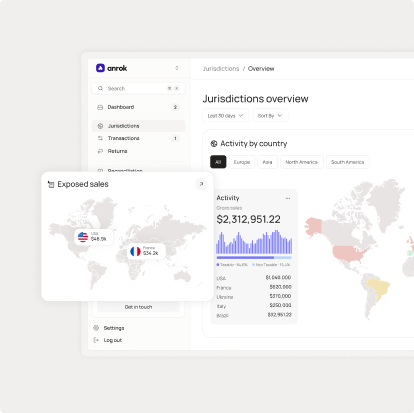
Want to know where you actually stand? Anrok offers a free compliance assessment for scaling DTC brands. We'll map your nexus, flag gaps, and show you what "clean" looks like. Get your free assessment today.
Analysis based on data from 1,000+ companies processing $1.4B/month through Anrok, combined with state-by-state research on DTC-specific compliance requirements.